
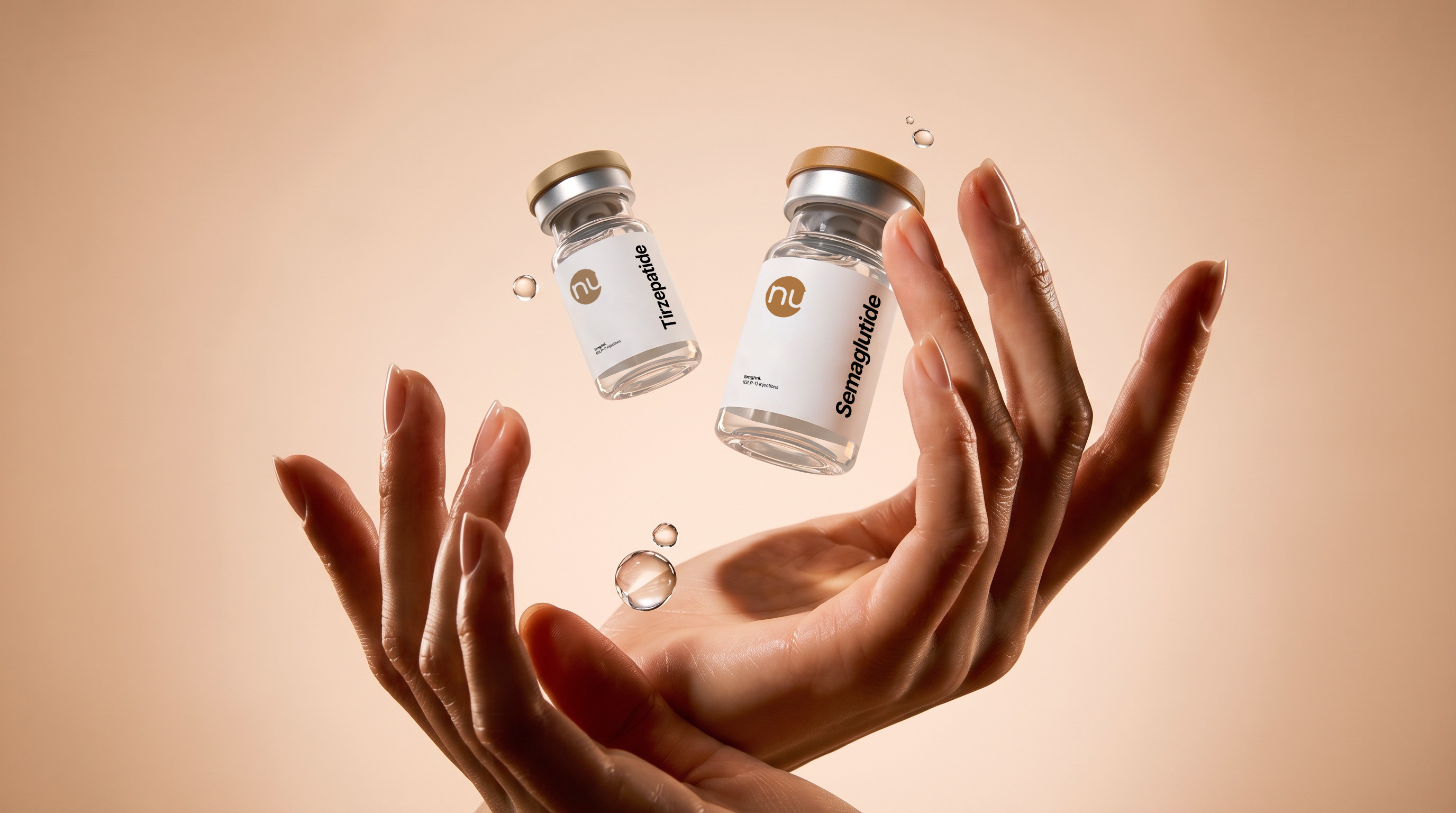
Semaglutide or Tirzepatide? What to Know Before Your Online Visit

Semaglutide and tirzepatide are the two prescription options people ask about most in medical weight management. They are related, but they are not the same medication, and neither one is right for everyone. This guide explains how they differ so you can have a better conversation with the licensed provider who reviews your case. It is educational and does not replace medical advice.
The short version
Semaglutide acts on one hormone pathway (GLP-1). Tirzepatide acts on two (GLP-1 and GIP). Both are prescription-only, both are started at a low dose and adjusted gradually, and both carry similar safety considerations. Which one a provider prescribes, if either, depends on your health history, your current medications, and how you have responded to treatment before.
Side by side
How each medication works
GLP-1 is a hormone your gut releases after eating. It signals fullness to the brain, slows how quickly the stomach empties, and plays a role in blood sugar regulation. Semaglutide mimics that hormone.
Tirzepatide mimics GLP-1 as well, and it also activates receptors for GIP, a second gut hormone involved in how the body handles nutrients. That dual action is the main pharmacological difference between the two.
What the research does and does not tell you
Most published evidence, including a head-to-head trial comparing the two, was produced with the FDA-approved brand-name products. In that trial, tirzepatide was associated with greater average weight reduction than semaglutide in adults with obesity who did not have diabetes.
Keep three limits in mind when you read headlines like that:
- An average across a study group does not predict any one person's experience.
- Trial participants also followed nutrition and activity guidance.
- Results from brand-name products cannot be assumed for compounded formulations, which have not gone through FDA review.
FDA status: what "compounded" means
The semaglutide and tirzepatide prescribed through Nu Image Medical are compounded medications prepared by state-licensed compounding pharmacies. Compounded drugs are not reviewed or approved by the FDA for safety, effectiveness, or quality. They are not generics, and they are not the same products as the FDA-approved brand-name medicines that contain these active ingredients.
Federal and state rules on compounding GLP-1 medications have been changing, and availability can vary by state. Your provider and care team can tell you what applies where you live at the time you enroll.
Weekly injection or daily tablet
Either medication may be prescribed in one of two formats:
- Weekly injection. A small subcutaneous injection you give yourself once a week at home. It suits people who prefer one scheduled moment per week.
- Daily rapid-dissolve tablet. A tablet that dissolves in the mouth once a day. It suits people who want to avoid needles or who travel often.
One practical safety point for injections: compounded vials are measured with a syringe, and dosing mistakes are a known risk. Before your first dose, confirm the amount with your care team in both milligrams and syringe units, and ask again every time your dose changes.
What it costs
Nu Image Medical programs are cash-pay. The monthly rate depends on the medication, the format, and the supply length you choose, and longer supplies generally lower the monthly rate.
- Semaglutide injection: from [$XX] per month
- Semaglutide RDT: from [$XX] per month
- Tirzepatide injection: from [$XX] per month
- Tirzepatide RDT: from [$XX] per month
Pricing can change, so confirm current rates during enrollment. Do not assume commercial insurance will cover a compounded GLP-1 program.
Safety information that applies to both
Medications in this class share several important considerations. The FDA-approved products carry a boxed warning about thyroid C-cell tumors seen in rodent studies. People with a personal or family history of medullary thyroid carcinoma, or with Multiple Endocrine Neoplasia syndrome type 2, should not use them.
Common side effects are digestive: nausea, diarrhea, vomiting, constipation, and stomach discomfort, most often when a dose is started or increased. Less common but serious problems include pancreatitis, gallbladder disease, dehydration that can affect the kidneys, and low blood sugar when combined with certain diabetes medications.
Tell your provider if any of these apply to you:
- You are pregnant, planning a pregnancy, or breastfeeding. These medications are not used during pregnancy.
- You take birth control pills. Tirzepatide can reduce how well oral contraceptives work around the time of starting and each dose increase.
- You have a history of pancreatitis, gallbladder problems, kidney disease, or diabetic eye disease.
- You have a surgery or procedure with anesthesia scheduled.
Seek urgent care for severe abdominal pain, persistent vomiting, or signs of an allergic reaction.
Five things your provider will weigh
- Your medical history. Certain conditions rule out both medications.
- What you take now. Including diabetes medications and oral contraceptives.
- Previous experience. Whether you have used a GLP-1 before and how you tolerated it.
- Format and routine. Weekly injection versus daily tablet, and which one you will realistically keep up with.
- Your goals and budget. Including whether a non-GLP-1 program, such as WAYT-less, is a better fit.
The provider may prescribe semaglutide, tirzepatide, a different program, or no medication at all.
How the online visit works
Nu Image Medical was founded in 2004, has provided care online since 2008, and works with providers licensed in all 50 states.
- Create an account and complete your health history online.
- A licensed provider reviews your information, generally within one business day.
- If treatment is appropriate, the provider builds your plan and writes the prescription.
- A licensed compounding pharmacy prepares the medication and ships it in discreet packaging.
- You follow your plan with access to the care team for questions and dose adjustments.
Common questions
Can I switch from one medication to the other?
Sometimes. A provider decides whether a switch makes sense and how to handle the dose change. Do not switch or combine them on your own.
Do I have to choose before I enroll?
No. You can share your preference, and the provider will recommend an option after reviewing your history.
Is a tablet as well studied as an injection?
Most published research on these medications involves injections. Compounded rapid-dissolve tablets have not been evaluated by the FDA, so talk through format with your provider.
How long do people stay on treatment?
It varies. Your provider will review your progress and decide with you whether to continue, adjust, or move to a maintenance plan such as WAYT-tain.
Your next step
If you would like a licensed provider to review whether semaglutide, tirzepatide, or another plan fits your health history, you can begin with the Nu Image Medical online weight loss evaluation.
Compounded medications are prepared by state-licensed compounding pharmacies and are not reviewed or approved by the FDA for safety, efficacy, or quality. Prescription products require an online consultation with a licensed healthcare provider, who will determine whether a prescription is appropriate.
Notas antes de publicar:
- Precios: dejé [$XX] porque la web se contradice. El home dice semaglutide desde $89, la página de semaglutide dice $99, el artículo actual dice $98, y tirzepatide inyectable aparece a $89 en su página y a $289 en la de semaglutide. Pídele a Andreas o David los valores correctos; vale la pena unificarlos en todo el sitio.
- Description Tag: tu CMS corta ese campo en cada coma (en tu pantallazo la descripción quedó partida en tres etiquetas). Por eso la escribí sin comas; pégala como una sola.
- Links internos: no puse ninguno. Si los agregan, los anclajes naturales son "semaglutide" y "tirzepatide" en la sección de formatos, "WAYT-less" en la lista del proveedor y "online weight loss evaluation" en el cierre.
- Estatus FDA: el 30 de abril de 2026 la FDA propuso dejar semaglutide, tirzepatide y liraglutide fuera de la lista 503B, y el periodo de comentarios cerró el 30 de julio. No encontré la decisión final, así que el artículo solo dice que las reglas están cambiando. Confirma con el equipo legal antes de publicar, porque el disclaimer del sitio menciona farmacias 503B. bgovblackhealth
- Byline: la Dra. Tambakis-Odom debe revisar el texto de verdad antes de poner "Reviewed October 2026", sobre todo la sección de seguridad.
Mándame el siguiente.
Sources:
This article is for informational purposes only and does not constitute medical advice. The information contained herein is not a substitute for and should never be relied upon for professional medical advice. Always talk to your physician about the risks and benefits of any treatment. Nu Image Medical may not offer the medications or services mentioned in this article.